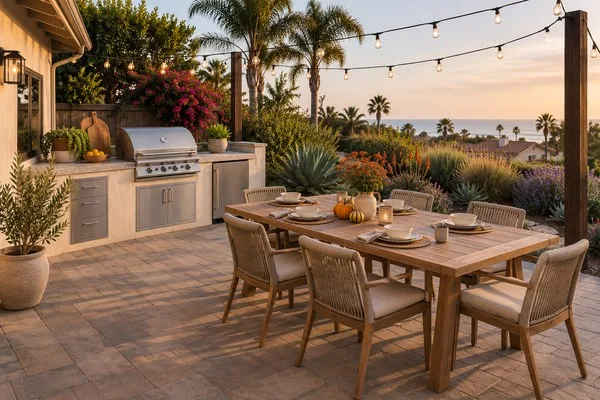
If you want to host Thanksgiving outdoors, the best layouts bring cooking, seating, shade, and circulation seamlessly together. In Oceanside, a well-planned outdoor kitchen and patio can handle a holiday crowd in late November and still earn its keep on an ordinary Tuesday in March.
If you are reading this in November, this year's turkey is probably still going in the oven inside. Next year's doesn't have to. A good outdoor living space takes planning before anyone breaks ground, and that planning is where Panjia Outdoors starts every project.
Want to start sketching it out? Reach out to our team or call (888) 600-9270 to book a design consultation.
How Big Should an Outdoor Kitchen Be to Cook for a Crowd?
Big enough that the cook has counter space on both sides of the grill and guests have somewhere to sit that is not in the cook's way. Size it for your biggest regular gathering, not your average weeknight.
The layout we build most often is a built-in grill with counter on each side and storage underneath. One side catches platters coming off the heat. The other holds whatever is going on next. From there it can grow into a side burner, a sink, a fridge, or a pizza oven.
For a crowd, the smartest add is usually a raised bar ledge. It gives guests a place to lean, snack, and talk to the cook without drifting into the work zone, which is exactly where holiday kitchens get crowded.
The footprint has to fit the lot, too. A narrow South O yard a few blocks from the pier calls for a single compact cooking station with a bar. A wider lot out in Rancho del Oro might fit the full run plus a dining table. Our outdoor kitchens are sized to the space and the way you actually host.
Where Should the Outdoor Kitchen Go Relative to the House and the Afternoon Breeze?
Put it close enough to the house that the trip from the indoor kitchen is short, and turn it so the afternoon ocean breeze carries smoke away from the table and the back door.
Oceanside gets a steady onshore breeze most afternoons, blowing in off the water and pushing inland. A grill set upwind of the dining area means everyone eats in a haze of smoke, and it can drift right into the house when the slider is open.
Homes on the west-facing slopes of Fire Mountain feel that breeze more than most. There, a seating wall or a pergola on the ocean side can block just enough wind to keep napkins on the table while still leaving the view open.
Circulation matters as much as wind. Leave a clear path from the back door to the grill that does not cut through the dining area, so the person carrying a hot pan never has to squeeze past chairs. We plan the kitchen, seating, fire feature, and shade as one layout under our outdoor living work, so the pieces fit together instead of fighting for the same corner.
What Paver and Counter Materials Hold Up to Coastal Sun and Salt Air?
Choose materials that shrug off UV and moisture: sealed pavers, porcelain or well-sealed granite or concrete counters, and stainless hardware wherever metal is exposed.
Within a couple of miles of the pier, salt air reaches everything. Cheap finishes on handles, hinges, and appliance trim start pitting and rusting first. Stainless components hold up far better near the water, and that is where we steer clients who live close to the coast.
For counters, we build on a masonry block frame faced in stone or stucco, then top it with granite, porcelain, or sealed concrete. Porcelain handles sun and spills with very little fuss. Granite and concrete look great too, as long as they stay sealed.
Underfoot, lighter paver colors stay cooler in afternoon sun, which matters when kids are running around barefoot after dinner. A sealer helps pavers resist stains from grease and dropped gravy, and a solid compacted base keeps the patio flat for years instead of settling around the kitchen.
How Does Landscape Lighting Extend Your Outdoor Living Into the Evening?
Good lighting lets the party keep going after sunset, which comes early around Thanksgiving. Warm, low-voltage LED light on paths, steps, and seating makes the space safe and comfortable without feeling like a parking lot.
We use 12V low-voltage LED systems and keep color temperature in the warm 2700K to 3000K range. Path lights wash the walkway, recessed lights go into step risers, and strip lights can tuck under a seating wall cap. Wiring can run inside pergola beams so nothing dangles.
Near the coast, the marine layer brings a lot of moisture, so fixtures need an IP65 rating or higher. Every package includes a timer and photocell, and the final aiming happens on a nighttime walkthrough. Our landscape lighting is planned with the patio, not added as an afterthought.
Most kitchen builds take about two to four weeks on site once permits clear, and design and permits come first. So the best time to start is well before the next holiday you want to host outside. Book a design consultation and we will walk your yard, talk through how you like to host, and start the plan. You can also call us at (888) 600-9270.