Retaining Wall Construction in San Diego
A retaining wall is structural, not decorative, so it has to be built for the soil and the slope behind it. Panjia has worked as a retaining wall contractor in San Diego since 2008, building walls with our own in-house crews that hold the grade and move water the right way.
Wall types and materials
The right material depends on the height of the wall, the load behind it, and the look you want. We build in three main systems.
Concrete masonry block, or CMU, gives you a reinforced core that handles taller walls and heavier loads. We face it with stucco or stone veneer so the structure disappears behind the finish.
Natural stone reads as the most permanent option and suits properties where the wall is meant to be part of the landscape. It takes more hand work to build, and that shows in the result.
Segmental block systems from Belgard and Orco interlock without mortar. For shorter walls, they rely on engineering and proper backfill instead of a poured footing. They come in a range of colors and textures and install efficiently, and we build to the manufacturer's specifications on every one.
Engineering and drainage
This is the part that separates a wall that lasts from one that leans, cracks, or fails. Every wall we build is sized for the soil load and the slope behind it. Taller walls and walls holding significant load get engineered drawings, and San Diego County requires permits once a wall passes a set height or holds a surcharge above it. We handle that process so the wall is built to code and signed off.
Drainage is what most failed walls get wrong. Water builds up behind a wall and adds pressure the wall was never designed to hold, and that pressure is what pushes walls over. We build the drainage in from the start: clean gravel backfill behind the wall, weep holes or a perforated drain pipe to carry water away, and proper compaction so the soil stays where it should. A wall can look perfect on day one and fail three winters later if the water behind it has nowhere to go.
We saw this on a sloped lot in Escondido, where runoff had been collecting against the back of the property. The new retaining wall held the grade, and with the drainage built in correctly, it moved the water off the slope instead of letting it pool.
What retaining walls are used for
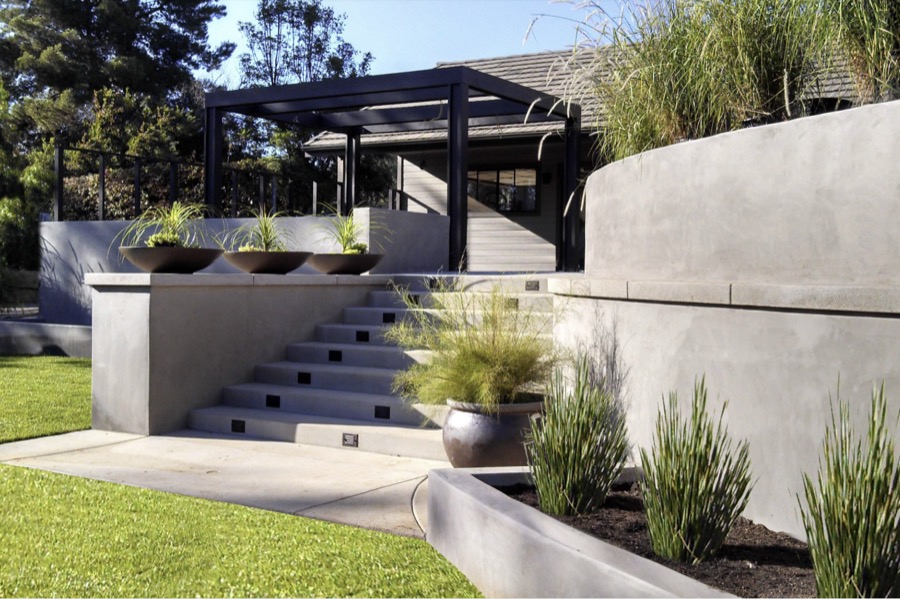
Most of our walls do one of a few jobs. The most common is holding back a slope so the ground above stays where it belongs. Terracing comes next, cutting a steep or unusable hillside into level sections you can actually use for a patio, a lawn, or planting. Lower walls work as garden borders and raised beds that give a yard structure. And because we design and build hardscape with our own crews, we often pair retaining walls with pavers so the wall, the patio, and the steps are planned as one project instead of three.
Our process
- Consultation. We come to the property, look at the slope and the soil, and talk through what the wall needs to do. You get an honest read on scope and budget.
- Design. We lay out the wall, the material, and how it ties into the rest of the yard, so you can see it before anything gets built.
- Permits and engineering. Taller walls get engineered drawings, and we pull San Diego County permits where the height or load requires them. We manage the submittals and the inspections.
- Build. Our in-house crews handle excavation, the footing or base, the wall itself, the drainage, and the backfill and compaction behind it.
- Walkthrough. We walk the finished wall with you, confirm the drainage is doing its job, and fix anything that needs it.
Pricing
Retaining walls start around $4,500. The price scales with the height of the wall, the length, the material you choose, and whether the wall needs engineering. A short garden border in segmental block sits at the lower end. A tall structural wall with engineered drawings, stone facing, and a full drainage system runs higher. Use that number as a guide, not a quote. We give you a real figure once we have seen the slope and the soil.
Areas we serve
We build retaining walls across North County San Diego, including San Marcos, Carlsbad, Escondido, and Encinitas.
Panjia has worked as a retaining wall contractor in San Diego County since 2008, based in San Marcos, California, license #928978. Every wall is engineered for its site and built by our own crews.
"The retaining wall they built solved a drainage problem we had for years. It looks great and the crew was professional from day one."
Retaining Wall Questions
What material is best for a retaining wall?
It depends on the height and the load. Concrete masonry block handles taller, heavier walls and takes a stone or stucco finish. Natural stone is the most permanent looking and suits walls meant to be part of the landscape. Segmental block from Belgard and Orco works well for shorter walls and installs without mortar. We recommend the material based on what your slope actually requires, not on what is easiest to install.
Do I need a permit for a retaining wall, and does height matter?
Height is the main trigger. San Diego County requires permits once a wall passes a set height or holds a surcharge, such as a driveway or a structure sitting above it. Taller walls also need engineered drawings. We handle the permits and the engineering coordination as part of the project, so the wall is built to code.
How do I keep a retaining wall from failing?
Drainage and compaction. Most walls that fail do so because water builds up behind them with nowhere to go, and that pressure pushes the wall over time. We build in gravel backfill, weep holes or a perforated drain pipe, and proper compaction so water moves through instead of collecting. The structure matters too, but bad drainage is what takes down walls that otherwise look fine.
How much does a retaining wall cost?
Walls start around $4,500 and scale with height, length, material, and engineering. A consultation is the only way to get an accurate number, since the slope and the soil drive a lot of the cost. We look at the site and give you a real figure.
Can a retaining wall give me more usable yard?
Yes. Terracing a slope into level sections is one of the most common reasons people build them. A hillside that is too steep to use becomes one or two flat areas for a patio, a lawn, or a garden. We plan the terraces around how you want to use the space.
Have a slope that needs holding?
Send us the site and we will schedule a free visit to look at the slope and the soil across San Diego County.