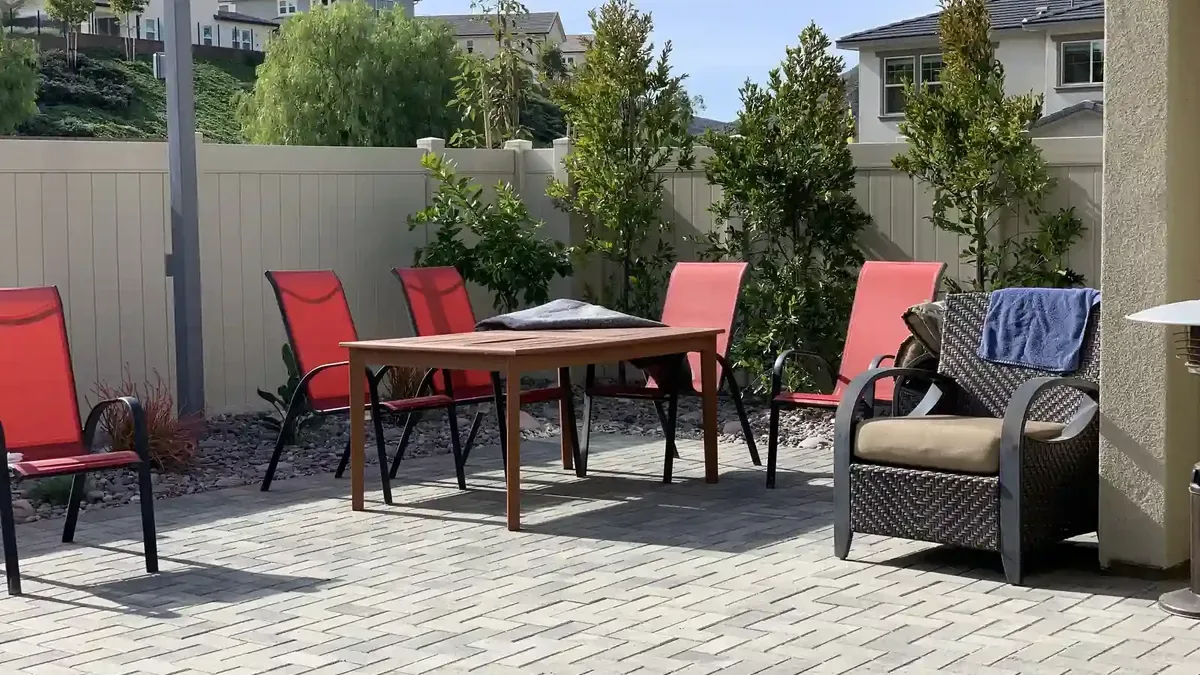
If you are pricing a new patio or driveway in San Diego, it usually comes down to two options: poured concrete or interlocking pavers. Concrete is cheaper to put down. Pavers cost more up front and tend to be worth it over the life of the project. Here is the honest comparison, without the sales pitch, so you can decide what fits your yard and your budget.
Up-front cost
Concrete wins on day one. A poured slab is the lower initial cost, and for a tight budget or a purely functional surface, that is a fair reason to choose it. Pavers cost more to install because there are more materials and far more labor: the excavation, the base, the sand setting bed, laying each unit, and the edge restraints that hold it all together. What you are paying extra for shows up later, not on the invoice.
Cracking and the San Diego ground
This is where the two really split. Concrete is one solid slab, so when the ground moves, and San Diego soil does move with heat, moisture, and clay, the slab has nowhere to flex. It cracks. Control joints guide where, but they do not prevent it. Pavers are individual units set on a flexible base. They shift with the ground instead of fighting it, which is why a proper paver surface can go decades without the spider-cracking you see on older concrete.
Repairs tell the real story
A stained or cracked concrete slab is hard to fix cleanly. You patch it and it shows, or you break it out and re-pour. With pavers, if a unit is ever damaged or something is spilled that will not come out, you lift that one paver and drop in a replacement. The repair disappears. If you ever need to reach a pipe or line underneath, the same thing applies: pull the pavers, do the work, put them back. A slab means a saw and a patch.
Drainage and heat
Concrete sheds water across its surface toward wherever it slopes. Pavers have joints between them, so water can work into the base rather than sheeting off, which helps with runoff. On a hot day, the joint lines and the surface texture of pavers also tend to feel less like a griddle than a broad concrete slab in full sun.
Look and resale
Concrete is concrete. You can stamp or color it, but it reads as a slab. Pavers come in a range of shapes, colors, and patterns, and they give a yard a finished, custom look that buyers notice. For a home you plan to sell, a paver patio or driveway generally reads as an upgrade in a way a plain slab does not.
The base is what actually lasts
Whichever you pick, the surface is only as good as the base under it, and this is where cheap installs fail. For pavers, we excavate to the right depth, lay a geotextile fabric to separate the soil from the base, build and compact a proper aggregate base, set the pavers on a sand bed, and lock the whole field in with edge restraints. Skip any of those steps and the prettiest pavers still shift and settle. Done right, that base is what carries the project for decades.
Which one should you pick?
Choose concrete when the budget is tight and the surface is purely functional, like a side yard or a utility pad. Choose pavers when you want the surface to last, look finished, and stay easy to repair, which is most patios, entryways, and driveways people actually spend time on. If you are not sure, that is exactly what a site visit is for.
See it on your own property
Panjia Outdoors installs paver patios, driveways, and walkways across San Marcos, Carlsbad, Vista, and the rest of North County San Diego, on a base built to hold up to local soil. We will walk your space, talk through both options honestly, and give you a written estimate. The first visit is free. Call (888) 600-9270 or request an estimate. CA License #928978.