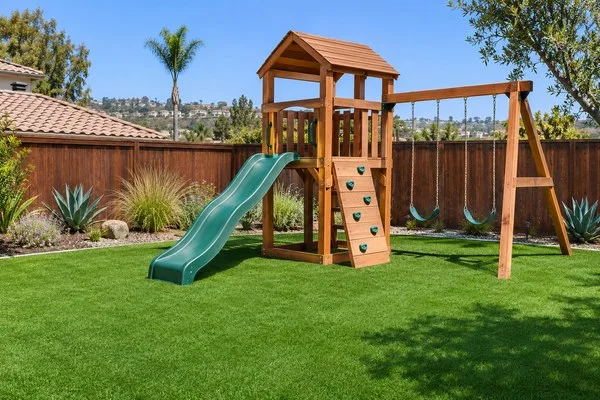
If you're considering turf for your playground area, it's important to have the right kind of supporting surface designed for the demands of the play area. Playground turf is synthetic turf built to be landed on, and in a Rancho Bernardo backyard it beats dirt, wood chips, or worn grass once it sits on the right base.
At Panjia Outdoors, our own crews install synthetic turf across North County San Diego. Play areas get their own spec instead of leftover lawn turf.
Is the swing set sitting in a dust patch right now? Reach out to our team or call (888) 600-9270 for a playground turf quote.
What Makes Playground Synthetic Turf Different From Regular Lawn Turf?
Playground turf carries deeper infill and usually a heavier face weight than standard landscape turf. Lawn turf is built to look good. Play turf is built to take falls.
Under the swing set, the infill does most of the cushioning work. For backyard play areas we use IntegriTurf with Durafill infill at extra depth, and we set that depth to the fall height of your specific equipment. We confirm that fall height at the site visit instead of guessing from a photo.
Infill choice matters more inland. Neighborhoods like Bernardo Heights and Westwood get warmer in summer than the beach towns, which is part of why we do not recommend crumb rubber for home playgrounds here. It runs hot and can off-gas. Durafill is the better fit for a yard your kids use barefoot.
Our playground turf page lays out the full spec, from the turf itself to the infill and seams. The short version: if the turf was picked for how it looks from the patio, it was picked for the wrong job.
Why Does the Cushioning Under Swings and Slides Matter So Much?
Because that is where kids hit the ground hardest and most often. The landing zone under a swing and at the bottom of a slide takes nearly all the jumps, tumbles, and dragged sneakers in the yard.
Any kid who has learned to bail off a swing at Rancho Bernardo Community Park will try the same move at home, usually at the top of the arc. You want the ground there to be the softest spot in the yard, and it rarely is.
Worn grass turns to packed dirt right in those spots, and packed dirt is hard. Wood chips start out soft, then get kicked out of the exact holes under the swings where you need them most. What is left is a shallow pit with a ring of chips scattered across the lawn.
With playground turf, the cushion stays where it was installed. The deeper infill settles down into the fibers, so it does not wander off the way loose chips do. We also seam every panel with an overlapping S-Seam method, because a lifted seam near a slide is a trip waiting to happen.
That seaming and base work is the same care that goes into every artificial turf installation we do, tuned for a play area.
How Do Drainage and Base Prep Keep a Play Area Usable After Rain?
A compacted base that drains keeps the play area firm and dry after a storm. Without one, turf sits on soft dirt that puddles, ruts under the swings, and goes lumpy over time.
We start by digging out about 3.5 to 4 inches of existing soil. Then we bring in Class II road base and compact it in lifts to 95% compaction, and on play areas we check how the soil underneath drains before anything goes on top. A 25-year weed barrier goes down next.
We prefer Class II over decomposed granite for the base, since DG softens when it gets oversaturated. That is the last thing you want under a swing set after a wet week in January. If your yard has gophers, we can lay gopher wire under the base too.
Plenty of Rancho Bernardo yards also sit on a grade. On our Rancho Bernardo landscape project in The Trails, we used retaining walls and terraces to turn cut-back hillsides into level, usable ground. A play area on a slope needs that same thinking first: a flat, stable pad, then the turf.
Is Playground Turf Easier to Keep Up Than Mulch or Wood Chips?
Yes, by a wide margin. Mulch and chips need raking, refilling, and picking out of the house, while playground turf mostly needs a hose and a leaf blower.
Loose fill is a chore that never ends. Chips scatter into the lawn, break down, ride inside on socks, and need topping off to keep any cushion at all. One windy week can move half of it to the neighbor's side of the fence.
Turf upkeep is short. Hose it off now and then. Run a leaf blower over it for leaves and debris, keeping it light so the infill stays put. In very high-traffic spots, plan on an infill top-up after several years. That is about it.
You also stop dealing with splinters, muddy shoes after rain, and the bare ring of dirt around the swing legs. The turf is the easy part to choose. What keeps it working for years is the right supporting surface underneath, built for how kids actually play.
If your play set is still sitting on dirt or chips, book a consultation and we will measure the area, check the fall height of your equipment, and put together a playground turf quote. You can also call us at (888) 600-9270.